Powering Enterprise AI: Why Data Matters More Than You Think
Kashish Karnick
Sr. Product Manager | Asia Pacific
Lenovo Data Storage Solutions
Kashish Karnick
Sr. Product Manager | Asia Pacific
Lenovo Data Storage Solutions
Most organizations begin their AI journey by asking a simple question:
“Which AI model should we use?”
For CIOs and business leaders, however, the more important question may be:
“What happens when the AI model changes?”
The AI industry is moving at an extraordinary pace. Organizations may use one model today and a different model tomorrow. The model that appears best-in-class today could be replaced within months by a faster, cheaper, more accurate, or more specialized alternative.
That is why organizations should think differently about AI models and business knowledge.
AI models are increasingly available to everyone. They can be licensed, subscribed to, consumed as a cloud service, or downloaded as open-source software. Your competitors will often have access to the same models that you do.
Your business knowledge is different.
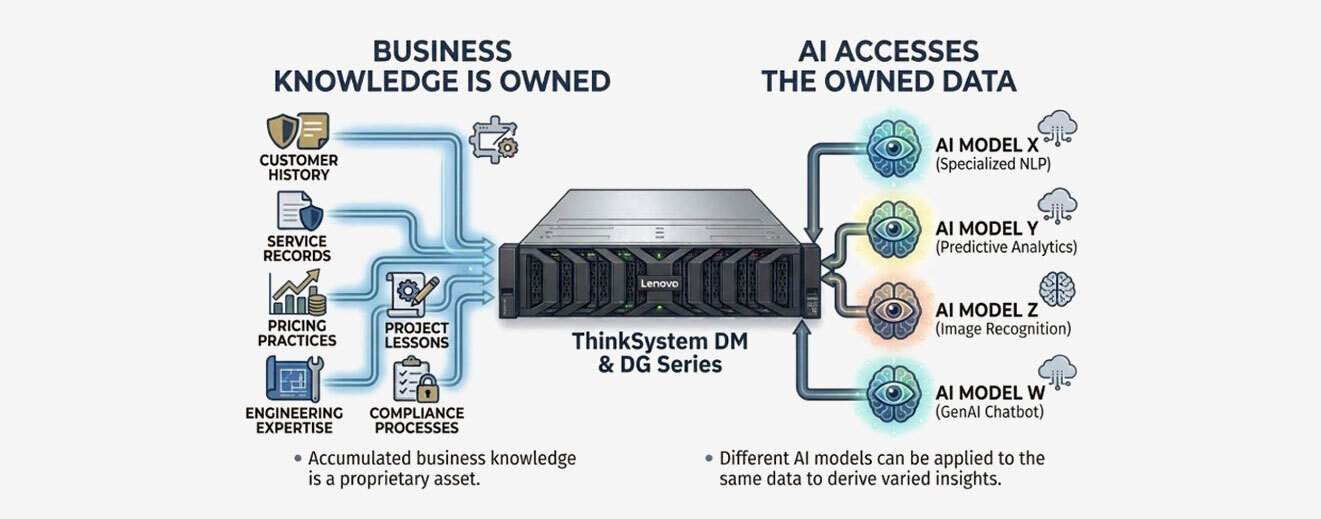
No competitor has your customer history, operational know-how, service records, engineering expertise, pricing practices, project lessons, compliance processes, or institutional experience. That accumulated knowledge is often one of the most valuable assets an organization owns.
This leads to a simple principle:
Own Your Data. Rent The AI.
What does that mean?
It means treating AI models as replaceable and your business knowledge as strategic.
The AI model is the engine. Your data is the fuel.
Organizations should expect AI models to evolve continuously over the coming years. Rather than building an AI strategy around a single model, they should build a strategy around their own knowledge.
When business information is organized, protected, governed, and accessible, organizations gain the flexibility to adopt new AI models as they emerge without rebuilding their AI strategy from scratch.
Whether the next generation of AI comes from OpenAI, Anthropic, Meta, NVIDIA, Lenovo, an open-source community, or a company that does not yet exist, the same business knowledge can be used to ground, enrich, and customize those models.
The AI may change. The Data remains.
From RAG to Agentic AI
This is one of the key reasons Retrieval-Augmented Generation (RAG) has become such an important enterprise AI architecture.
Instead of continually retraining models whenever business information changes, RAG connects AI systems to trusted enterprise data. The model provides reasoning and language capabilities, while the organization’s knowledge provides context, accuracy, and business relevance.
The next evolution is Agentic AI.
RAG helps AI find the right answer.
Agentic AI helps AI take the next step and perform work.
An AI agent may search documentation, validate business rules, create service tickets, update records, trigger workflows, notify stakeholders, or coordinate downstream processes. In other words, Agentic AI moves beyond answering questions and begins helping organizations automate and simplify business operations.
For that to work, AI needs more than a model.
It needs access to business context.
It needs to understand customer history, operational procedures, approval processes, policies, compliance requirements, and institutional knowledge accumulated over years of running the business.
The value of enterprise data becomes even greater in an Agentic AI world. Every future agent will need business context to make good decisions, and that context comes from enterprise knowledge, not from the AI model itself.
To make this vision a reality, organizations need more than GPUs. They need a way to connect AI to trusted business information, eliminate data silos, and ensure that critical knowledge remains protected and governed throughout its lifecycle.
Why AI Projects Need Data More Than GPUs
When people think about AI infrastructure, they naturally focus on compute.
GPUs are important. They provide the processing power needed to run large language models and generate responses quickly.
But GPUs alone do not make AI useful.
An AI system can only answer questions or perform actions using the information available to it. If product documentation is stored in one location, contracts in another, application data on block storage, and archives in object repositories, the challenge is no longer compute.
The challenge is data.
Finding it.
Accessing it.
Protecting it.
Governing it.
For most enterprise AI deployments, the bottleneck is not model performance.
It is data accessibility.
The organizations that extract the greatest value from AI are typically the organizations that can efficiently connect AI systems to trusted, well-managed business knowledge.
This becomes even more important as organizations move beyond chatbots into Agentic AI, where AI systems are expected not only to understand information, but also to act on it.
To explore how organisations can put this data-first approach into practice, continue to Part 2 Data Storage Solutions for Enterprise AI which examines how validated Lenovo AI platforms and unified storage can help move AI from concept to production. For a deeper technical view, download Lenovo Hybrid AI Platform 201 for Enterprise RAG with Red Hat AI Enterprise to explore a validated architecture for secure, scalable Retrieval-Augmented Generation and private AI workloads.